

Antoine Reicha and the Making of the Nineteenth-Century Composer
Partenaire

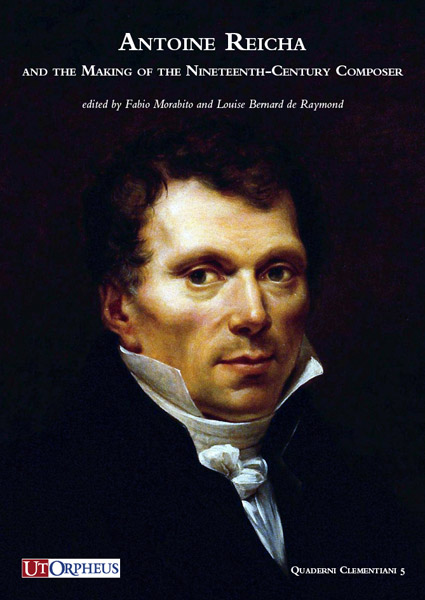 Livre collectif en anglais et français sous la direction de Fabio Morabito et Louise Bernard de Raymond. Bologna : Ut Orpheus, 2020. Avec le soutien du Palazzetto Bru Zane.
Le compositeur du XIXe siècle souffre d'un problème d'image persistant : inspiré, non mondain, masculin, écrivant des œuvres de génie pour la postérité. Si le projet des musicologues des 30 dernières années a été de contourner ce portrait-robot, il persiste néanmoins comme une mauvaise odeur.
Ce livre utilise Antoine Reicha (1770-1836) comme étude de cas pour développer des approches alternatives du compositeur du XIXe siècle. Le fait que Reicha ait été, par exemple, un professeur de composition et un auteur prolifique de manuels pédagogiques offre l'occasion de s’intéresser (avec de nouveaux types de sources) aux tentatives menées par les compositeurs pour devenir compositeurs.
Comment les saisir dans l’action, en explorant non pas un ensemble d'œuvres et de réalisations, mais les priorités et les angoisses de ces individus (le savoir qu'ils ont suivi ou créé) dans l'élaboration de leurs identités artistiques pour le public ? Quels modes d'historiographie et d'analyse musicale pourraient aider à explorer la musique de Reicha et de ses contemporains au-delà de la cartographie des traditions locales ou nationales et de leur transfert ?
Un modèle d'écriture de l'histoire de la musique en réseau – que nous pourrions appeler "une histoire de la musique sans protagoniste" – peut-il aider les musicologues à travailler sur les compositeurs non canoniques sans en faire rétrospectivement des monuments ? Ces questions, parmi d'autres, constituent l’essence de ce volume, pour réévaluer non seulement Reicha, mais aussi notre boîte à outils disciplinaire : se demander comment/pourquoi/à quelle fin la musicologie raconte des histoires sur les compositeurs.
Table des matières
Fabio Morabito & Louise Bernard de Raymond – The Composer as Process
Paris in Vienna, Vienna in Paris
Fabio Morabito – Making the Modern Composer in Haydn’s Image
Michael B. Ward & Fabio Morabito – Texture as Structure: Concerto Elements in the String Quartets by Rodolphe Kreutzer, Pierre Rode and Antoine Reicha
Annette Richards – Envoicing the Virgin Warrior: Reicha’s 71 Glass Music for Marianne Kirchgessner
Music as Science
Ellen Lockhart – Antoine Reicha, Science, and the Origins of Music Theory
William O’Hara – The Composer as Master of All Developments
Teaching Reconsidered
Étienne Jardin – Des chemins d’élèves pour dessiner la voie d’un professeur au Conservatoire
Louise Bernard de Raymond – Une jeune fille apprend l’harmonie vers 1835: les leçons particulières de Reicha en haute définition
Alban Ramaut – Reicha vu par les dédicaces des traités de trois de ses élèves
Knowledge in Practice
Muriel Boulan – Entre rigueur et liberté́: quelle fugue pour le compositeur moderne?
Thomas Christensen – Reicha’s Cours de composition musicale: A Textbook for the New Century
Related persons
Permalink
publication date : 19/10/23